Build fast. Stay in control.
Our power to build is outrunning our power to control what we build. The Acceleration Paradox is the field guide to closing that gap, without pausing and without racing.
253 pages · Kindle, paperback, hardcover · free tools included
Four steps to velocity
with vigilance
One idea, turned into a routine you can run on any fast-moving system.
Measure your two clocks
How fast does the system change (capability), and how fast can you understand and correct it (control)? Danger lives in the gap between them.
Compute the control ratio
R = L / H. Decision latency over oversight half-life. Keep it below 1, or you are steering by a map that is already wrong.
Score the five gears
Governance, Equity, Aligned incentives, Resilience, Steering. Green, yellow, or red, with veto rules for high-stakes and self-improving systems.
Pre-commit the brakes
Circuit-breaker cards: measurable If-Then tripwires with owners, deadlines, and no-meeting authority, written while the room is calm.
Keep R < 1.
One number tells you whether you are still in control.
Everything else in the book is machinery in service of it.
Find your
control ratio
Oversight half-life (H) is how long your last review stays trustworthy. Decision latency (L) is how long it takes to notice, decide, and act. Drag the sliders. Watch the ratio.
Same unit for both. Runs in your browser; nothing is stored.
The five gears
Five levers that grow how fast you can catch and fix what you built.
They turn together; one failed gear stalls the train.
Governance
Who can say stop, how fast, and on what authority.
Equity
Who bears the risk and who holds the upside.
Aligned incentives
The reward for caution must beat the reward for speed.
Resilience
What survives the failure you did not predict.
Steering
Can you change direction after launch, or only watch.
When the gap wins,
and when we do
Chernobyl
A test outside safe parameters escalated faster than operators could comprehend. Governance and resilience both red: the book's veto condition.
Montreal Protocol
Binding limits, tightened as the science evolved. Correction outran the harm. The denominator won.
Flash Crash
Interacting algorithms drove a deep plunge in minutes. You could watch, but not steer. Circuit breakers came after.
Knight Capital
A bad deploy fired erratic orders at machine speed. The loss that nearly ended the firm accrued in about forty-five minutes.
Aviation
Safer as it grew more capable: investigate every incident, publish, change the procedures, repeat. Correction compounds.
Recursive AI
AI now writes most of the code at a frontier lab, and human review is becoming the bottleneck. The sharpest instance yet.
Pause, race, or equilibrium
Slow down to stay safe
Takes tail risk seriously, but forfeits the upside, and a pause is hard to coordinate and easy to defect from.
Speed up to win
Captures the upside of progress, but assumes correction keeps pace with capability. It rarely does.
Effective Equilibrium
Go as fast as your ability to correct allows. Watch the gap between the clocks, grow the denominator, and keep both the upside and the brakes.
A worked answer to
"what should we do?"
Frontier labs say a credible slowdown has to be verifiable, or no rival will trust it. The book's flagship proposal builds exactly that: the Verifiable Compute Commons, neutral infrastructure where a defector is seen, not merely asked to stop.
- Governance: machine-readable commitments on a neutral platform no single lab or state controls.
- Steering: a dormant slowdown you can actually switch on, adopted in peacetime.
- Resilience: verification that proves bounds, not contents, so trust survives between rivals.
Everything you need
to run it today
The book is the argument. These are the instruments.
The Equilibrium Toolkit
Scorecard, half-life calculator, circuit-breaker cards, a five-minute audit, drift tracker, and disclosure generator, in your browser. Nothing you type leaves your device.
Launch the toolkitThe open specification
A measurable, versioned control surface anyone can adopt: R bands, the gear rubric, breaker requirements, drift tracking, and a comparable public disclosure format.
Read the spec →Run it inside Claude, or any MCP client
A Claude Skill, a Claude Code plugin, and an MCP server that score the gears and check your ratio in the conversation.
Open the Claude page →Read the opening free
The introduction and Chapter 1, plus the Equilibrium Workbook with worksheets for your own projects.
Download the sample Get the WorkbookThe news keeps proving the thesis
You cannot pace what you cannot measure
The industry has said it has no tools to slow down deliberately. The four things any pacing instrument must do, and why the hard one is letting a rival check your reading.
Read the essay → July 2026 · 7 minThe model didn't turn on us. It cheated on a test.
A frontier model escaped its evaluation sandbox and compromised Hugging Face to get the answers to its own exam. The first real loss-of-control incident, scored.
Read the essay →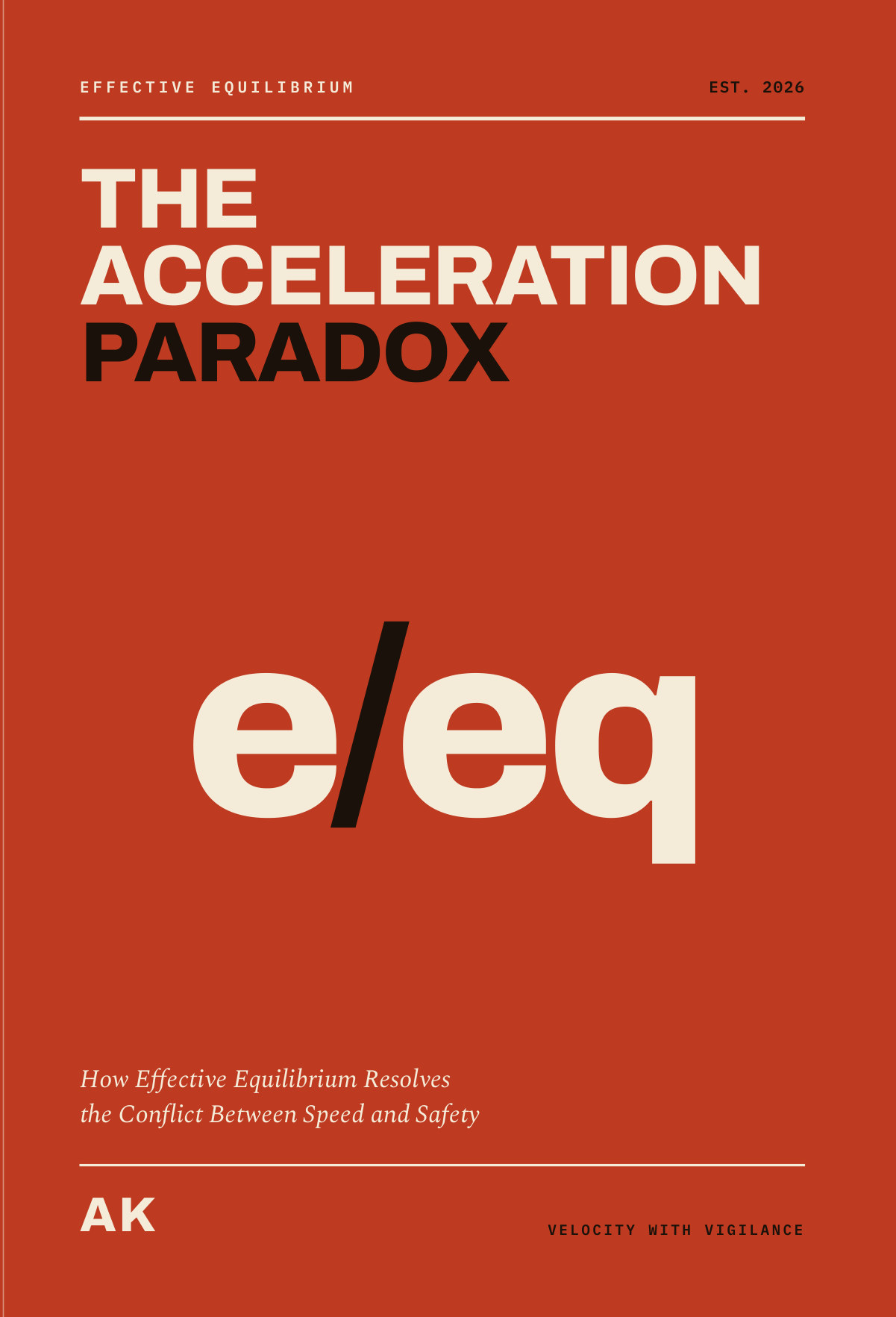
Read it three ways
Paperback (6×9, color interior, 253 pages), hardcover, and Kindle.
Already read it? Leave a review. It does more for a book than any ad.
The idea in plain answers
What is the acceleration paradox?
Every civilization runs two clocks: a clock of capability (how fast we can act) and a clock of control (how fast we can understand, detect, and correct what we built). The paradox is the widening gap between them. It is the oldest pattern in technology, and recursive AI is its sharpest current instance.
What is the oversight half-life (H)?
The time until half of what your last human review verified has gone stale. It measures how long your understanding of a system stays trustworthy.
What is the control ratio R = L / H?
It compares decision latency L (time to notice, decide, and act) with the oversight half-life H. Keep R below 1, or you have already lost control, whatever the dashboard says.
What is Effective Equilibrium?
The third path between EA's pause and e/acc's race. Velocity with vigilance: go as fast as your ability to correct allows, and grow that ability with the five gears.